
artigo ·Public policy·Industry·Innovation
COP31: the transition I saw accelerate in the corridors of Antalya
In the pavilions of Antalya, companies, banks and governments presented targets, projects and capital, and the circular economy gained a numerical target for 2035.
Vinicius Saraceni, Circular Movement· · 6 min de leitura
By Vinicius Saraceni, executive director of Circular Movement*
I read the headlines about COP31 with the feeling of someone who had attended a different conference at the same address. The UN climate conference ended on Sunday, 22 November, after two days of overtime, with the Antalya Pact, the main political decision, stalled over the dispute on fossil fuels¹.
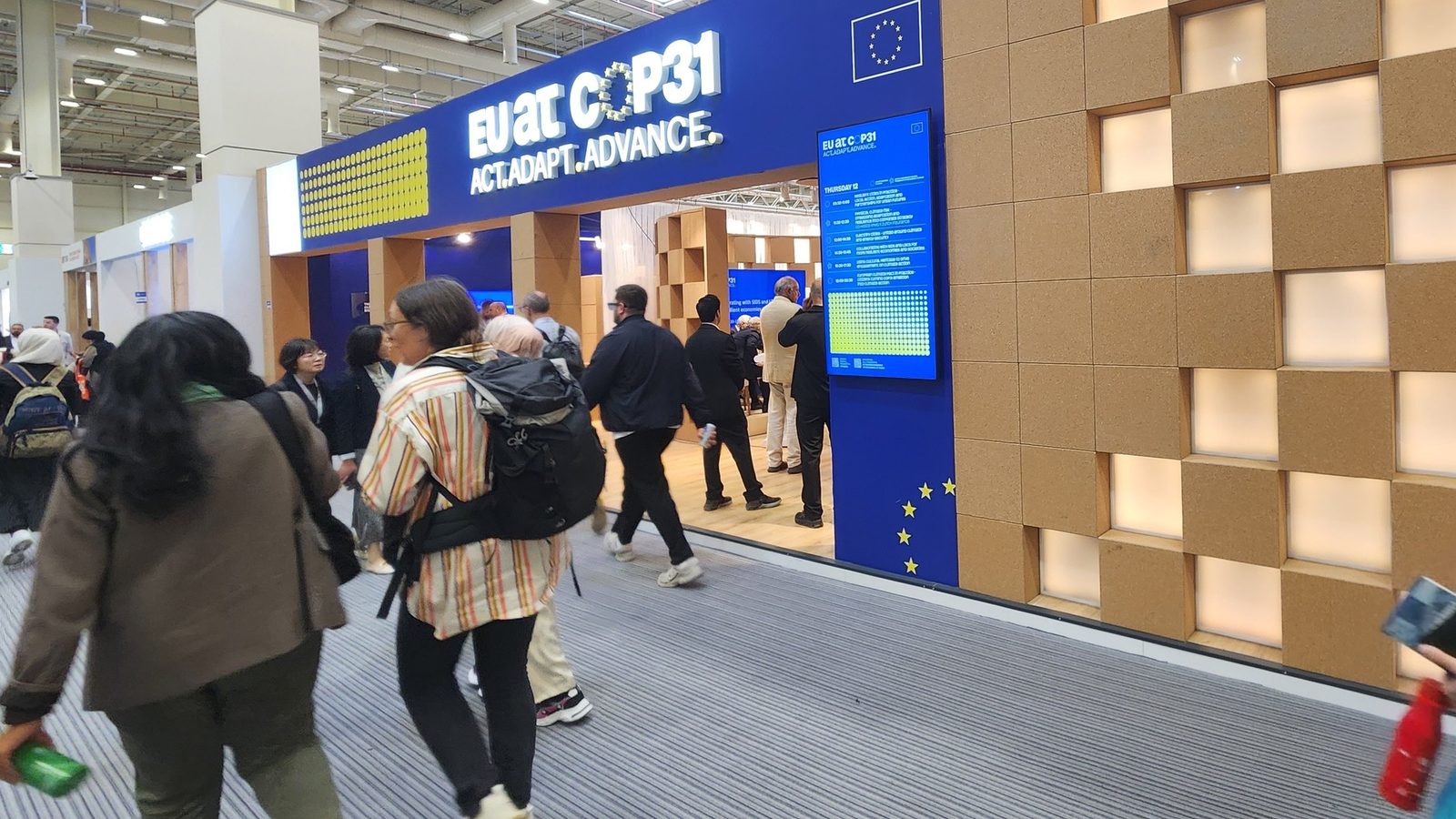
Antalya received 92,934 registrations for in-person attendance², which should make it the largest COP on record. One in five badges belonged to an official country delegate. What did the other four go there to do? Many of them worked in the second layer of the COP, the implementation layer, which runs alongside the negotiation among almost 200 countries and brings together governments, companies, banks, cities and civil society organisations. That is where I spent the week.
The Blue Zone pavilions
In the Blue Zone, the accredited area, the pavilions of countries, coalitions and regional blocs filled entire corridors, almost all with their own auditorium and a programme running from morning to late afternoon. I saw full agendas, cases presented, contacts exchanged during breaks and conversations that began on a panel and continued over coffee. Even fossil fuels, the topic that stalled the final text, filled 82 events, against 7 at COP26 in Glasgow³.
This layer keeps its own scorecard, presented at a session I attended on 10 November. The Action Agenda, which brings together the voluntary commitments of companies, cities and governments, adds up to almost 500 initiatives, and 87% of the 120 acceleration plans launched at COP30 reported progress within a year³. Brazilian Dan Ioschpe, COP30 High-Level Climate Champion, summed it up: "plans are moving from paper to practice, and progress is something we can measure" (translated from Portuguese).
What caught my attention was who filled these rooms. Large consultancies, investment and development banks and international agencies were there with staff and a daily programme. This audience shows up when a market has taken shape.
Electrification gained 75 countries
The clearest example came from energy. The COP31 presidency proposed raising electricity's share of the world's final energy consumption from 23% to 35% by 2035⁴, and 75 countries and 94 organisations joined the commitment during the conference³. China gives a measure of the speed: electric and plug-in hybrid cars reached around 67% of new passenger car sales in the country in June⁵.
An economic sector with an annual meeting
The numbers explain the presence of banks and consultancies. The green economy already moves more than US$ 5 trillion a year and was the second fastest-growing sector in the world over the last decade, behind only technology⁶. That is why the COP has also become the great catalysing moment for this sector, the two weeks of the year when projects meet financiers, technology meets buyers and public policy meets those who will carry it out.
The circular economy gained a target and made it into the draft
For those working on the Circular Economy, Antalya left concrete signals. The Turkish presidency placed zero waste at the top of the ten themes of its Action Agenda and set targets for 2035, among them halving the projected growth of municipal solid waste. The global circular material use rate, currently at 6.9%, is to reach at least 15%⁴.
The topic reached the negotiated text. Paragraph 38 of the proposed Antalya Pact recognises, among other points, the circular economy and zero waste efforts as important elements of climate action⁷. The proposal, however, stopped short of adoption, and the wording remained as a reference for the next round.
On 11 November, Emine Erdoğan, First Lady of Türkiye, presented the Global Zero Waste Alliance, with zero waste and the circular economy in the first of its five areas of work⁸. The next day, the Istanbul Platform launched the first cohort of Zero Waste Districts, with 20 districts, one of them in Brazil, and a target of reaching 100 in five years³.
There is a well-known reason for so much attention. Renewable energy and energy efficiency address around 55% of global emissions, and the other 45% come from how the world makes and uses products, materials and food⁹. That is where the circular economy acts.
Brazil arrived with a measurement instrument
Brazil brought the second largest delegation to the conference, with 1,994 accredited participants², and filled the auditoriums with proposals. On 10 November, at the Brazil Pavilion, I took part in the panel of the Brazilian Agency for Industrial Development (ABDI) on traceability, circularity and public procurement.
The heart of the conversation was Recircula Brasil, a platform built by ABDI with the plastics industry that uses Brazil's electronic invoice (nota fiscal eletrônica) to prove the origin and destination of recycled plastic. On the panel I argued that this document gives the country a strategic advantage, because it makes it possible to follow the material at every transaction, from disposal back to the factory.
Three days later, ABDI announced Rastreia BR, which extends traceability to chains such as textiles, glass and steel. According to the agency, the tool will be integrated into the Istanbul Platform to track the progress of circular economy initiatives¹⁰. This is the measurement Ioschpe was talking about, and Brazil arrived in Antalya with a way to do it.
Capital begins to take position
In the second auditorium, the conversation was about capital. On 12 November, at the pavilion of the National Confederation of Industry (CNI), I moderated a panel on how to finance the transition to a circular economy in companies. With me were Sebrae, Fiesp, Ambev, the Brazilian Development Bank (BNDES) and UNEP FI, the finance initiative of the UN Environment Programme.
The session opened with a new CNI study. From 2020 to 2025, between R$ 31 billion and R$ 90.7 billion were associated with the circular economy in Brazil, from 3.5% to 10.3% of the country's sustainable finance¹¹. By CNI's count, 80.8% of the mapped resources went to the end of the chain, to recycling, waste treatment and material recovery, and 7.7% reached design, prevention and efficiency in the use of inputs. The study recommends directing more resources to this beginning of the chain, and that is where I see the most room to grow.
On the same day, Aloizio Mercadante, president of BNDES, presented three climate funds selected by the bank. They target R$ 13 billion in capital and, with the credit that this capital attracts, around R$ 39 billion in investment¹². Eco Invest Brasil, a federal blended finance programme, has already mobilised more than US$ 36 billion in five auctions³.
The declared focus of the funds is clean energy and the decarbonisation of industry, in sectors such as steel and cement. The call that selected them includes waste and the circular economy among its investment areas¹². For the Brazilian company that has a structured circular business and can demonstrate the emissions it avoids, there is capital looking for projects.
Where the opportunity lies
The negotiation continues in 2027, on the way to COP32 in Addis Ababa, Ethiopia, and every round is worth following. I left Antalya with one reading: Brazil already has an instrument to measure the material that returns to industry and is beginning to have capital to finance that return. The next step is to bring these instruments to those who have the project, and that is where Circular Movement works, with the around 100 organisations in its ecosystem.
The question I bring back from Antalya is: which project in your organisation is ready to meet this capital?
Vinicius Saraceni is executive director of Circular Movement, a platform for influence, intelligence and connections for the Circular Economy, created in 2020 by Atina Educação. At COP31 in Antalya: speaker on the ABDI panel on traceability and moderator of the CNI panel on financing the circular transition.
Notes and sources
¹ UN News and Carbon Brief, 22 and 23 November 2026.
² UNFCCC provisional lists, analysed by Carbon Brief on 10 November 2026. Of the 92,934 registrations, 18,812 were official delegates. The Brazil total adds up the country's delegates and guests. The final number comes out after the conference.
³ Climate High-Level Champions, Action Agenda scorecard at COP31, 23 November 2026. Dan Ioschpe quote in free translation.
⁴ COP31 Presidency, third letter to the Parties, 28 August 2026. The 6.9% rate comes from the Circularity Gap Report 2025.
⁵ Ember, China Energy Transition Review 2026, September 2026, with data from the Chinese carmakers' association.
⁶ World Economic Forum and Boston Consulting Group, Already a Multi-Trillion-Dollar Market, December 2025.
⁷ UNFCCC, draft decision FCCC/PA/CMA/2026/L.25, 22 November 2026.
⁸ Hürriyet Daily News, 13 November 2026.
⁹ Ellen MacArthur Foundation, Completing the Picture, 2019.
¹⁰ ABDI and Folhapress, 17 November 2026. The expansion to the new chains begins in early 2027.
¹¹ CNI, Financiamento para a Economia Circular na Indústria Brasileira (Financing for the Circular Economy in Brazilian Industry), October 2026, with 43 operations mapped.
¹² Agência BNDES de Notícias and Exame, 12 November 2026. In the broadcast alongside President Lula, Mercadante mentioned R$ 51 billion for the climate agenda (Brasil 247 and ICL Notícias). BNDES Climate Call: InfoMoney and ClimaInfo, 26 January 2026.
*This text was automatically translated with the help of artificial intelligence and reviewed. Still, there may be slight differences compared to the original version in Portuguese.
This content stays open because many people support it.
The Círculo do Movimento brings together those who give every month, from R$ 17.
Cancel whenever you want, in one click.
citar este artigo
VINICIUS SARACENI, CIRCULAR MOVEMENT. COP31: the transition I saw accelerate in the corridors of Antalya. Movimento Circular, November 25, 2026. Available at: https://movimentocircular.io/en/blog/cop31-the-transition-i-saw-accelerate-in-the-corridors-of-antalya.
Your organization already has a circular agenda. What is its next step?
See how to take part