
artigo ·Fundamentals
Environment Day... Again…
The Circular Economy connects climate action, urban resilience, and regeneration to help build more sustainable futures.
· 5 min de leitura

Prof. Dr. Edson Grandisoli
Do you usually see the glass as half full or half empty?
In general, communications surrounding Environment Day tend to focus on the half-empty glass. Deforestation, climate change, environmental injustice, pollution, biodiversity loss — in short, a wide range of socio-environmental challenges that interact with and reinforce one another.
Climate change can lead to longer periods of drought, which increase the likelihood of wildfires and forest fires, impact biodiversity, and contribute to a rise in respiratory illnesses, especially among the most vulnerable populations. This is just one example of how actions affecting the environment generate multiple social and environmental consequences.
So where is the half-full glass?
It's right here, reading this article. Interested in issues that extend far beyond your own immediate concerns and that relate to the present and future of humanity and all other forms of life on Earth. And this is no coincidence.
Different expressions of empathy and altruism have been encouraged through decades of work by governments, NGOs, activists, and people who believe that what is common to all must be preserved, and that by doing so we move toward a better, fairer, and more inclusive world. And we know that this is no small achievement.
Over the past few years, I have devoted much of my time to trying to better understand complex issues such as climate change and its many consequences for ecosystems and living beings. At the same time, through my work with the Movimento Circular, I have come to recognize that the Circular Economy is becoming increasingly strategic—not only for fostering technological innovation, but also for giving us the opportunity to step back, move beyond our limited perspectives, and better understand the complexity of our relationships with the environment and with other social actors.
The lens of the Circular Economy, by focusing on our relationships with materials, energy, people, and the planet, encourages us to analyze and recognize the unsustainability of many of our individual and collective choices (the half-empty glass), while simultaneously fostering the emergence of new possibilities (the half-full glass). It points to pathways for action that connect the present with the future.
According to the Ellen MacArthur Foundation, for example, the energy transition alone will not be enough to address the climate crisis. While replacing fossil fuels with renewable energy sources could account for roughly 55% of the emissions reductions needed, the remaining 45% is directly linked to how we produce food, build cities, and use materials such as cement, steel, plastic, and aluminum.
Another key mechanism is expanding recycling, reuse, and remanufacturing. When aluminum, glass, plastic, paper, and steel return to production cycles, emissions associated with extracting virgin raw materials and highly energy-intensive industrial processes can be avoided. Studies indicate that circular strategies applied to the cement, steel, plastic, aluminum, and food sectors alone could reduce global emissions related to goods production by as much as 45% by 2050. (ICS)
Urban mobility can also be reimagined through a circular lens. More compact cities, integrated with public transportation, active mobility, and shared transportation systems reduce emissions and lessen dependence on fossil fuels. At the same time, they help improve air quality, public health, and overall quality of life.
Climate adaptation in cities
Perhaps one of the most powerful contributions of the Circular Economy lies in climate adaptation within cities.
Nature-based solutions provide a clear example of this connection. The restoration of urban rivers, creation of linear parks, expansion of green spaces, rain gardens, green roofs, and mangrove restoration help reduce flooding, improve water infiltration, mitigate urban heat islands, and enhance biodiversity. These strategies regenerate natural systems while simultaneously strengthening cities' capacity to withstand extreme events.
Circular water management is also becoming increasingly strategic as droughts and water crises intensify. Rainwater harvesting systems, greywater reuse, ecological sanitation, and permeable infrastructure create cities that are less vulnerable to water stress and climate impacts.
Organic waste offers another powerful example. Instead of being sent to landfills, where it generates methane—a potent greenhouse gas—it can be transformed into organic compost for urban agriculture, soil restoration, and the expansion of urban vegetation cover. In this case, mitigation and adaptation occur simultaneously: emissions are reduced while territories become more resilient to extreme heat, food insecurity, and environmental degradation.
In other words, the dialogue between climate emergencies and the Circular Economy is both unavoidable and urgent.
Perhaps one of today's greatest challenges is overcoming the notion that sustainability is limited to isolated actions or individual behavioral changes. Climate emergencies require structural transformations, integrated urban planning, consistent public policies, and collective participation. They require cities capable of regenerating, rather than simply consuming fewer resources and causing less harm.
Returning to the half-full glass, the Circular Economy offers something especially valuable in times of crisis: the possibility of building narratives about the future that are not based solely on collapse, but also on humanity's capacity to reorganize systems, rebuild relationships, and reinvent ways of living. To regenerate.
What brings me hope is seeing Environment Day gradually become Environment Week, Environment Month—and perhaps one day it will no longer need special recognition at all, because environmental considerations will be embedded in every decision we make, every single day.
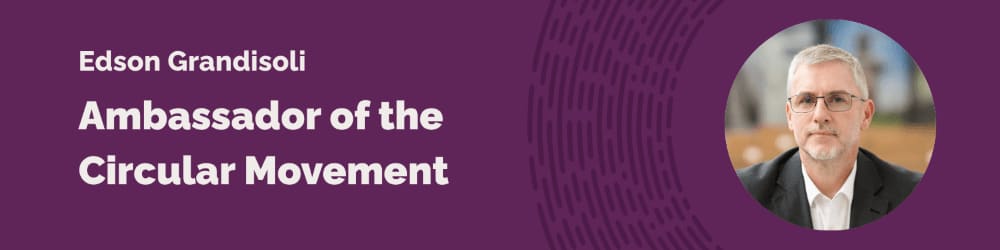
*Profº Dr. Edson Grandisoli
Ambassador and pedagogical coordinator of the Circular Movement. He holds a Master’s degree in Ecology, a PhD in Education and Sustainability from the University of São Paulo (USP), and a Postdoctoral degree from the Global Cities Program (IEA-USP). He is also a specialist in Circular Economy from the UN’s UNSCC. Co-creator of the Schools for Climate Movement, he is a researcher in the field of Education and associate editor of the journal Ambiente & Sociedade.
*This text was automatically translated using artificial intelligence and subsequently reviewed. However, minor differences may still exist when compared to the original version in Portuguese.
This content stays open because many people support it.
The Círculo do Movimento brings together those who give every month, from R$ 17.
Cancel whenever you want, in one click.
citar este artigo
MOVIMENTO CIRCULAR. Environment Day... Again…. Movimento Circular, June 5, 2026. Available at: https://movimentocircular.io/en/blog/environment-day-again.
Your organization already has a circular agenda. What is its next step?
See how to take part