
artigo ·Fundamentals
Paths toward a lighter future
Science, cooperation, and innovation show that reducing humanity's ecological overshoot is both possible and necessary.
· 7 min de leitura
Prof. Dr. Edson Grandisoli
Inspired by the ecological footprint concept developed in the 1990s, Earth Overshoot Day was launched globally in 2006 through an initiative by Andrew Simms of the New Economics Foundation in partnership with the Global Footprint Network. The date marks the point each year when humanity's demand for natural resources exceeds the Earth's ability to regenerate them within that same year. Since its creation, it has become one of the world's most widely recognized indicators of planetary health because of its clarity and educational value.
After 54 years of estimates, our impact on the planet is undeniable. Today, humanity spends nearly half the year operating in ecological deficit, consuming natural resources and generating waste faster than the Earth can recover. Despite the long-term trend illustrated by the data, however, Earth Overshoot Day shifted from July 24 in 2025 to July 30 in 2026—something that has occurred only 15 times over the past 54 years.
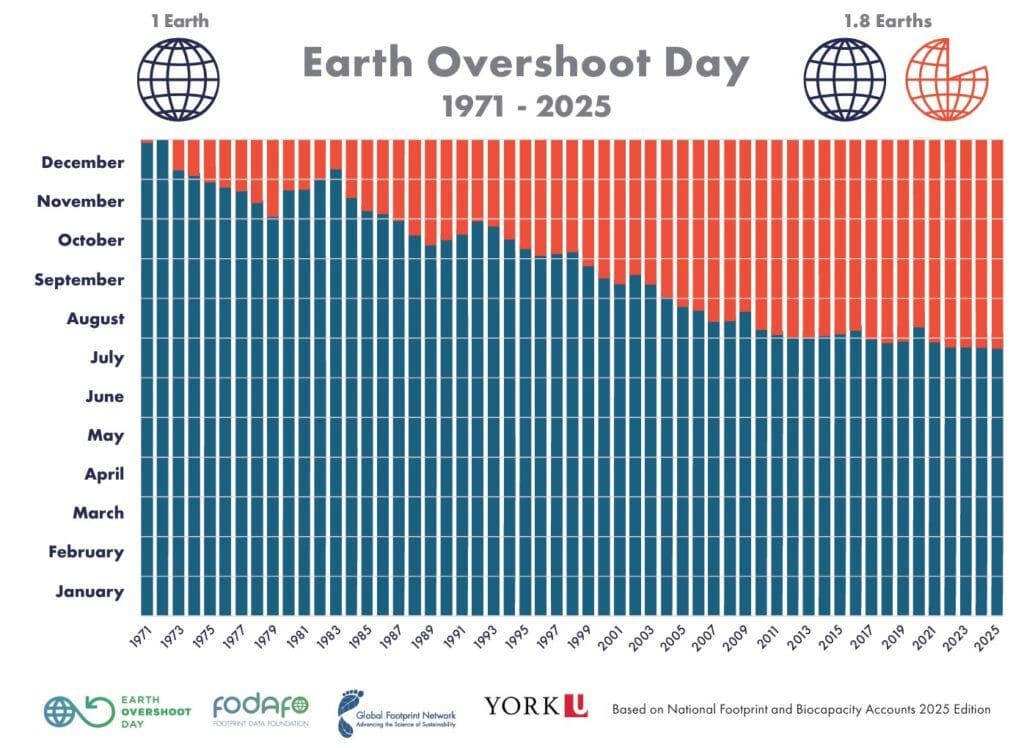
Earth Overshoot Day (1971–2026)
An honest assessment of planetary health today must embrace two ideas simultaneously: the overall situation remains critical, yet there are clear indicators showing that positive change is possible when science, regulation, investment, and international cooperation work together. In other words, although we are still far from the structural transformation needed, there are concrete signs that progress occurs when governments, businesses, institutions, and society act consistently and at scale.
In this context, Earth Overshoot Day 2026 offers an opportunity to communicate a more hopeful message. At first glance, the later date appears to represent direct environmental improvement. However, the Global Footprint Network explains that this change is primarily the result of methodological revisions rather than an actual reduction in humanity's pressure on natural systems. In fact, the underlying trends from the past year alone would have moved the date two days earlier; only the combination of updated calculations and worsening environmental indicators produced the apparent six-day delay.
The correct message, therefore, is that while the calendar provides a brief sense of relief, it does not yet reflect a meaningful reduction in ecological overshoot. Even so, for those who choose to see the glass as half full, it is important to recognize and celebrate genuine progress.
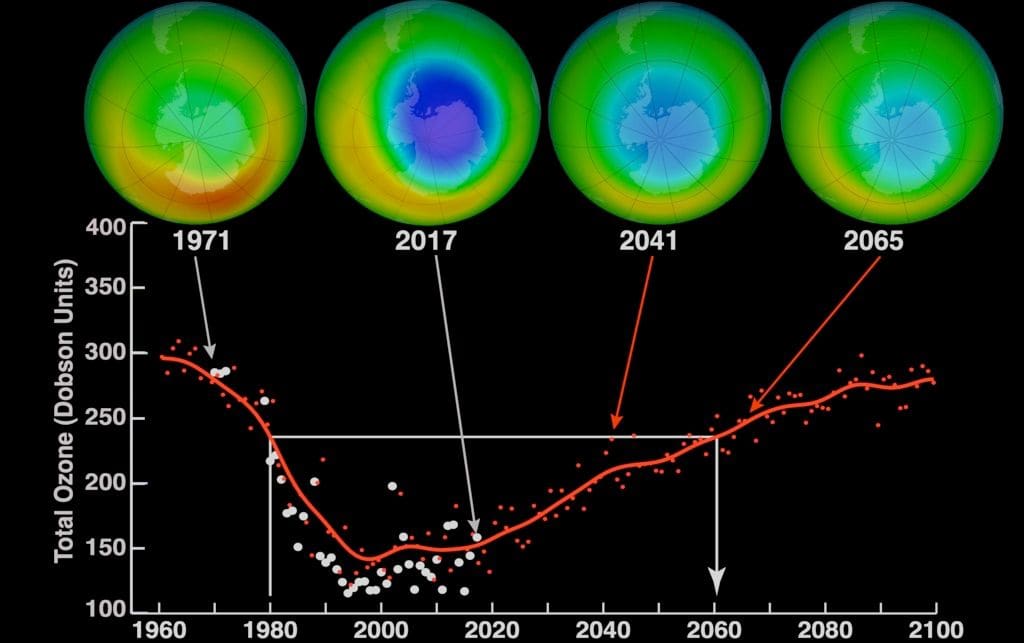
Perhaps the most iconic example is the recovery of the ozone layer. The Montreal Protocol (1987) led to the elimination of more than 99% of the production and consumption of ozone-depleting substances. As a result, the ozone layer continues to recover and is expected to return to its 1980 levels around 2040 across most of the world, by 2045 in the Arctic, and by 2066 over Antarctica, provided current policies remain in place. It remains one of the greatest success stories in environmental policy: a global problem identified by science, addressed through international cooperation, regulation, technological innovation, and continuous monitoring.
Another encouraging trend comes from the energy transition. In 2024, renewable energy installations reached a record level for the twenty-second consecutive year, adding nearly 700 GW of new generating capacity, with almost 80% coming from solar photovoltaic energy. For the first time, renewable energy and nuclear power together accounted for 40% of global electricity generation, while renewables alone supplied 32%.
This does not mean that global emissions are already declining at the pace required or that the world's energy matrix has become sustainable. It does, however, demonstrate that clean energy technologies have moved from the margins to the center of global electricity expansion.
There have also been important social advances directly connected to planetary health. By 2023, access to electricity had reached nearly 92% of the global population, reducing the number of people without electricity by 19 million compared to the previous year. Access to clean cooking solutions also continues to improve, although progress remains insufficient, reducing household air pollution for millions of families.
These indicators matter because planetary health is not only about conserving nature—it is also about creating safer, healthier, less polluted, and less vulnerable living conditions for people.
There has also been partial progress in protecting natural ecosystems. In 2024, 17.6% of terrestrial and inland water areas and 8.4% of oceans and coastal areas were under protection or conservation. Although this remains well below the international goal of protecting 30% of the planet by 2030, and management quality still varies significantly, the progress demonstrates that biodiversity conservation has become a global priority and that an institutional foundation already exists to accelerate further protection.
Air pollution also presents encouraging signs. One of the most significant milestones was the global elimination of leaded gasoline, announced by the United Nations Environment Programme (UNEP) in 2021 after a 19-year international campaign. The measure is estimated to prevent more than 1.2 million premature deaths every year.
The most encouraging message is not that "everything is getting better." Rather, it is that we already know how improvement happens. When clear goals, sound science, transparent data, public engagement, consistent public policies, adequate financing, and technological innovation come together, planetary indicators respond. The ozone layer recovers. Clean energy expands. Access to electricity improves. Some forms of pollution decline.
These achievements are still modest compared with the scale of today's interconnected crises, but they are significant enough to demonstrate that change is neither utopian nor hypothetical—it is already happening across multiple sectors and can be accelerated.
For this reason, Earth Overshoot Day 2026 should be understood as an invitation to reflection, collective action, and shared responsibility. The fact that the date moved six days later helps communicate that it is possible to "move the date." At the same time, the Global Footprint Network makes clear that 2026 still represents the highest level of ecological overshoot ever recorded. The challenge now is to transform isolated advances into lasting global trends.
References
FOOD AND AGRICULTURE ORGANIZATION OF THE UNITED NATIONS. Global deforestation slows, but forests remain under pressure, FAO report shows. Roma: FAO, 2025. Disponível no site da FAO. Acesso em: 29 jun. 2026.
GLOBAL FOOTPRINT NETWORK. Earth Overshoot Day 2026 falls on July 30. Geneva: Global Footprint Network, 2026. Disponível no site Earth Overshoot Day. Acesso em: 29 jun. 2026.
GLOBAL FOOTPRINT NETWORK. Earth Overshoot Day 2025 falls on July 24. Geneva: Global Footprint Network, 2025. Disponível no site Earth Overshoot Day. Acesso em: 29 jun. 2026.
HEALTH EFFECTS INSTITUTE. State of Global Air 2025: PM2.5. Boston: Health Effects Institute, 2025. Disponível no site State of Global Air. Acesso em: 29 jun. 2026.
INTERNATIONAL ENERGY AGENCY. Global Energy Review 2025: key findings. Paris: IEA, 2025. Disponível no site da IEA. Acesso em: 29 jun. 2026.
PLANETARY HEALTH CHECK. Planetary Health Check 2025: a scientific assessment of the state of the planet. Potsdam: Potsdam Institute for Climate Impact Research, 2025. Disponível no site Planetary Health Check. Acesso em: 29 jun. 2026.
UNITED NATIONS ENVIRONMENT PROGRAMME. Era of leaded petrol over, eliminating a major threat to human and planetary health. Nairobi: UNEP, 2021. Disponível no site do UNEP. Acesso em: 29 jun. 2026.
UNITED NATIONS ENVIRONMENT PROGRAMME. World must act faster to protect 30% of the planet by 2030. Nairobi: UNEP, 2024. Disponível no site do UNEP. Acesso em: 29 jun. 2026.
UNICEF; WORLD HEALTH ORGANIZATION. Progress on household drinking water, sanitation and hygiene 2000–2024: special focus on inequalities. New York; Geneva: UNICEF; WHO, 2025. Disponível no site UNICEF Data. Acesso em: 29 jun. 2026.
WORLD BANK. Tracking SDG 7: The Energy Progress Report 2025. Washington, DC: World Bank, 2025. Disponível no site do Banco Mundial. Acesso em: 29 jun. 2026.
WORLD METEOROLOGICAL ORGANIZATION. WMO Bulletin shows successful recovery of ozone layer, driven by science. Geneva: WMO, 2025. Disponível no site da WMO. Acesso em: 29 jun. 2026.

*Profº Dr. Edson Grandisoli
Ambassador and pedagogical coordinator of the Circular Movement. He holds a Master’s degree in Ecology, a PhD in Education and Sustainability from the University of São Paulo (USP), and a Postdoctoral degree from the Global Cities Program (IEA-USP). He is also a specialist in Circular Economy from the UN’s UNSCC. Co-creator of the Schools for Climate Movement, he is a researcher in the field of Education and associate editor of the journal Ambiente & Sociedade.
*This text was automatically translated using artificial intelligence and subsequently reviewed. However, minor differences may still exist when compared to the original version in Portuguese.
This content stays open because many people support it.
The Círculo do Movimento brings together those who give every month, from R$ 17.
Cancel whenever you want, in one click.
citar este artigo
MOVIMENTO CIRCULAR. Paths toward a lighter future. Movimento Circular, July 15, 2026. Available at: https://movimentocircular.io/en/blog/paths-toward-a-lighter-future.
Your organization already has a circular agenda. What is its next step?
See how to take part