
artigo ·Fundamentals
Circularity of used lubricating oil: green economy and lower dependence on petroleum
Re-refining used lubricating oil strengthens the circular economy, lowers emissions, and supports a more sustainable industry.
· 3 min de leitura
By Aylla Kipper
The green economy has gained increasing prominence in Brazil, offering significant potential to drive economic growth and industrial sustainability. A study by the AYA Institute indicates that the green economy could add up to US$430 billion to Brazil's GDP by 2030, highlighting the importance of low-carbon and sustainability strategies.
According to the United Nations Environment Programme (UNEP), this approach promotes greater resource efficiency, reduces environmental degradation, and supports the creation of sustainable jobs.
In this context, Brazil offers a successful example of a green economy. According to the National Agency of Petroleum, Natural Gas and Biofuels (ANP), the country re-refines approximately 400 million liters of Used or Contaminated Lubricating Oil (UCLO) every year. This significant volume not only reduces dependence on virgin base oils derived from petroleum but also lowers greenhouse gas emissions and generates direct and indirect employment throughout the sector. At a time when sustainability and the circular economy are becoming increasingly important, re-refining has established itself as a strategic solution for both industry and the environment.
Pioneering legislation
Even before Brazil's National Solid Waste Policy (PNRS) was enacted, CONAMA Resolution No. 362/2005 had already established shared responsibility across the lubricating oil supply chain, clearly defining the role of each stakeholder in the collection and proper disposal of used oil. This regulation was instrumental in positioning Brazil as a global benchmark in the sector.
One Brazilian example of proper UCLO management is Lwart Environmental Solutions, a re-refining company that uses hydrotreatment technology to go beyond an environmental solution by delivering a clear example of the circular economy. Through a zero-waste process, the company recovers valuable components from used lubricating oil, returning Group II base oil to the production cycle, treating the recovered water, and transforming other fractions of the waste into useful by-products. In addition to delivering environmental benefits, this process preserves valuable raw materials and promotes a more efficient and sustainable production model aligned with the principles of the green economy.
Learn more about UCLO reverse logistics
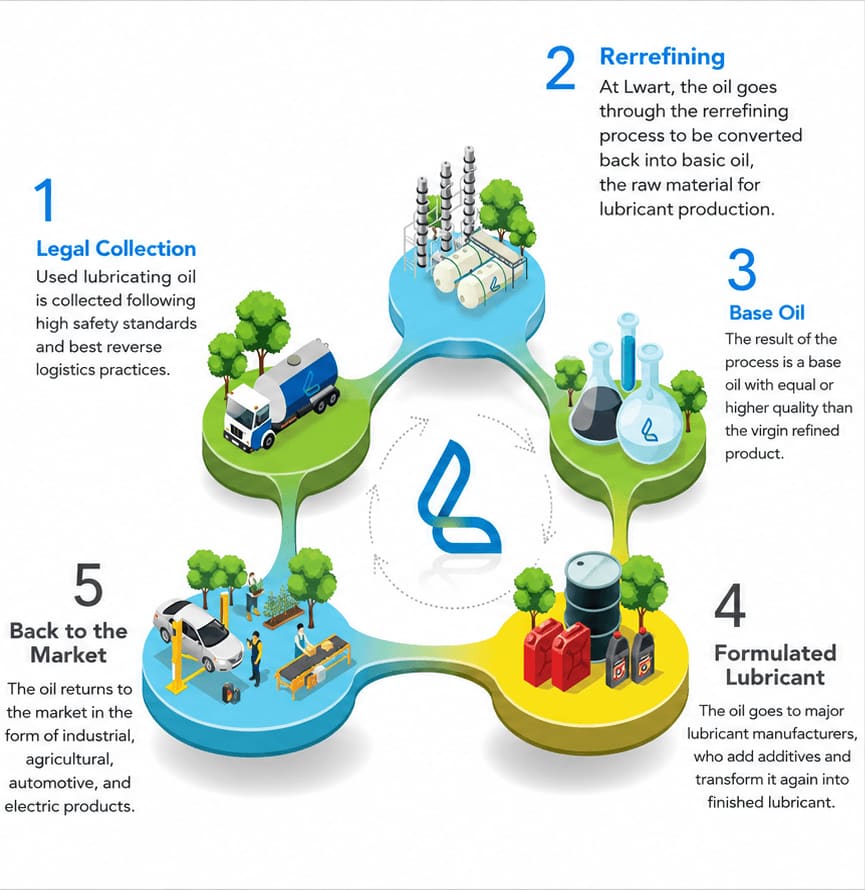
Lwart's work in managing used lubricating oil plays a key role in the circular economy by transforming waste into a high-performance, sustainable raw material. This model not only reduces environmental impacts but also strengthens industrial efficiency and competitiveness. The company, for example, is expanding its production capacity by 60%, representing a significant investment to further advance the circularity of used lubricating oil in Brazil.
With continued technological advances and investments throughout the sector, re-refining remains one of the pillars of the green economy, helping build a more sustainable future for industry and the planet.
About Lwart Environmental Solutions
Lwart Environmental Solutions is a 100% Brazilian company and the national leader in the collection and re-refining of Used or Contaminated Lubricating Oil. It is also the only producer in Latin America of high-performance Group II base oils manufactured from this waste stream. Sustainability is at the core of its business model, which also includes the collection, treatment, and transformation of various commercial and industrial solid wastes. Every year, the company serves approximately 116,000 customers, operates a re-refining plant in Lençóis Paulista, São Paulo, and maintains 22 temporary waste storage facilities across Brazil. More information is available at www.lwart.com.br.
Aylla Kipper is Head of Institutional Relations and Sustainability at Lwart Environmental Solutions. With more than 15 years of experience in corporate affairs, she works at the intersection of business, government, and society, bringing extensive expertise in ESG, crisis management, media relations, and stakeholder engagement. Throughout her career, she has developed projects and strategies focused on sustainability, the circular economy, waste management, social responsibility, and corporate reputation, helping organizations strengthen their role in addressing the challenges of sustainable development.
This content stays open because many people support it.
The Círculo do Movimento brings together those who give every month, from R$ 17.
Cancel whenever you want, in one click.
citar este artigo
MOVIMENTO CIRCULAR. Circularity of used lubricating oil: green economy and lower dependence on petroleum. Movimento Circular, August 11, 2026. Available at: https://movimentocircular.io/en/blog/circularity-of-used-lubricating-oil-green-economy-and-lower-dependence-on-petroleum.
Your organization already has a circular agenda. What is its next step?
See how to take part