
artigo ·Fundamentals
There is no Circular Economy without a Data Economy
This month, the Circularity Leader explores how data, traceability, and technology underpin the scaling of the Circular Economy with transparency and real impact.
· 8 min de leitura
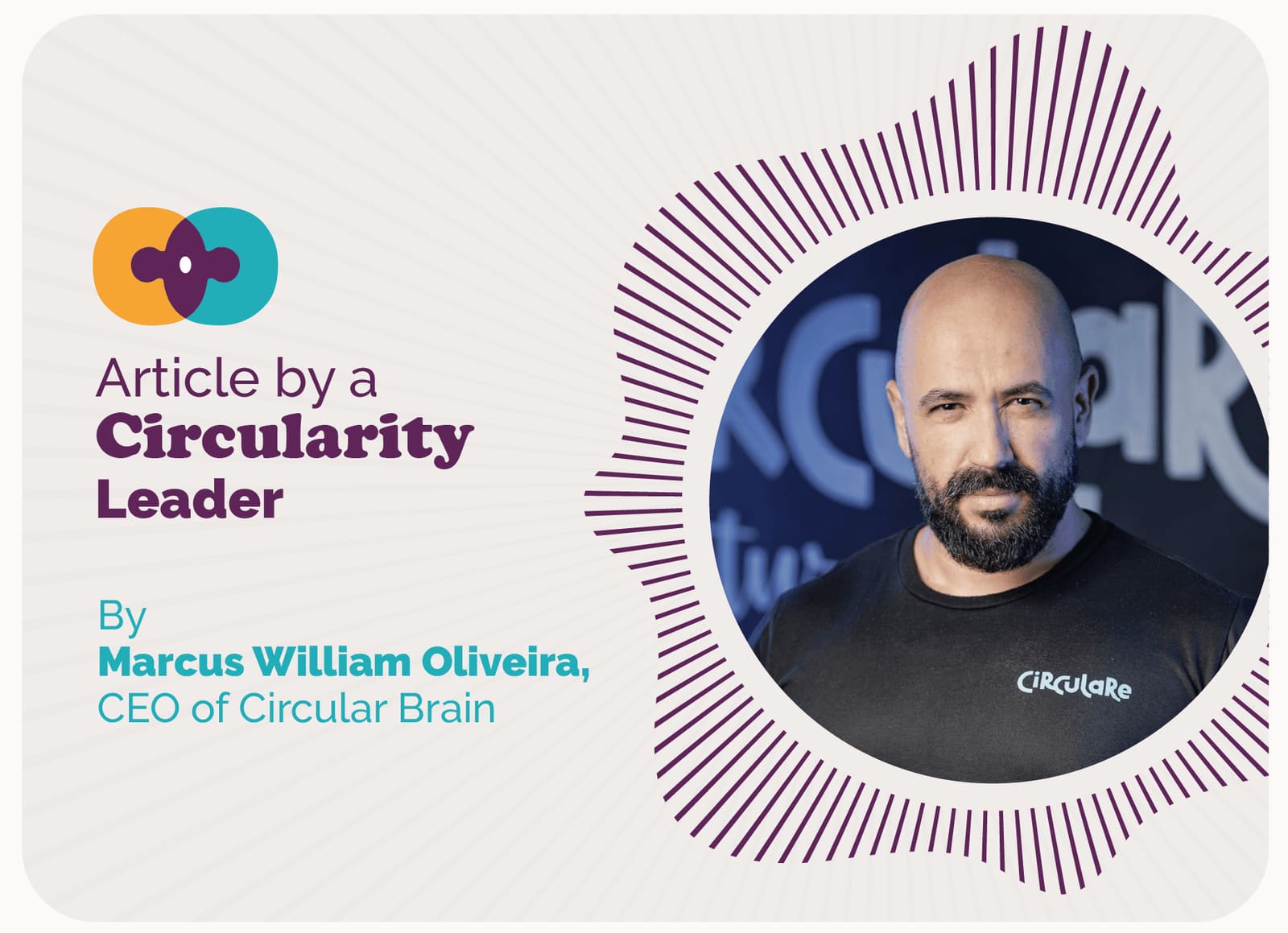
By Marcus William Oliveira, CEO of Circular Brain
In 2025, Circular Brain processed more than 80 thousand tons of electrical and electronic waste in Brazil. Thousands of household collections were carried out, covering 439 thousand kilometers across the country, in addition to the installation of 1,338 new drop-off points, which were added to a network of more than 17 thousand active locations in 100% of Brazilian municipalities. During the same period, the environmental education platform Multiplicadores Circulare surpassed 400 registered participants, and content related to the responsible disposal of electronics reached more than 180 million people through 1,413 media placements.
These figures help illustrate the scale that processes such as selective collection, recycling, and reuse—core stages of the Circular Economy - can reach when processes, data, and technology move forward together. But they also conceal something important: this journey did not begin with digital platforms, dashboards, or large data volumes. It began with a much simpler question: “How do we prove that we are doing the right thing?”
At the end of 2008, I made a decision that completely changed the course of my professional life. At the time, I was pursuing a PhD in Neuroscience at the Trinity College Institute of Neuroscience in Dublin, Ireland. My father had been working in recycling for more than 15 years, but the company he had just started faced a major challenge right at its inception. In the midst of the global financial crisis that was beginning in the United States, I decided to return to Brazil to help structure and run this new business, despite having no prior management experience.
In 2009, the environment was particularly challenging. Metals, which had traditionally supported the operation, lost market value, while at the same time— as often happens during periods of uncertainty—gold rapidly appreciated. The economic model that had worked until then no longer made sense, but it was in this context that the recycling of electrical and electronic products began to prove strategic. Not only because of the value of the materials, but also due to the complexity of the process, the need for proper treatment, and the socio-environmental impact involved. That was, in fact, the beginning of my journey into the world of electronics recycling, which was still in its early stages in Brazil.
Perhaps because of my academic background, my discomfort was always clear: I did not want the company to be just a commodity broker. The goal was to operate as a service provider capable of generating real socio-environmental value through the responsible management of these materials.
This led us, from the very beginning, to invest in licensing, certification, and operational infrastructure in order to serve large clients with responsibility, transparency, and socio-environmental compliance.
In 2011, I created what is, to the best of available knowledge, the first electronic waste traceability report in Brazil. Products were processed in a segregated manner, and each material fraction had its destination recorded in detail—still manually at that time.
But why add an extra layer of work and complexity when the market was not asking for it?
Because even then it was clear to me that traceability is the foundation of waste management. Without knowing exactly what comes in, how it is processed, and where it goes, there is no management—only operation—which significantly increases risk for service users. Over time, this concept evolved and has now become a minimum market standard.
From physical traceability to digital traceability
The principle has not changed. What has changed is scale. As recycling evolved into the broader concept of Circularity—encompassing global supply chains, regulatory targets, and corporate commitments—physical traceability became insufficient. It became necessary to transform processes into data flows, operational records into digital evidence, and production chains into end-to-end traceable systems.
For a long time, we talked about the Circular Economy as something essentially physical: products, materials, waste, recycling, reuse, reverse logistics. All of that remains true, but it is no longer enough.
Circularity only becomes real when it can be measured and proven. And in today’s world, proof is synonymous with reliable, auditable information.
That is why a statement gaining traction in international forums and technical studies makes so much sense: there is no Circular Economy without a Data Economy.
But when we talk about applying the Data Economy to the Circular Economy, a question naturally arises: if this is so important, why do we seem to have advanced so little?
My interpretation is that, in recent years, the focus had to be elsewhere. It was necessary to solve the basics: structuring operations, improving logistics efficiency, building processing capacity, and ensuring that waste was actually treated properly. This effort remains essential today, because without operational capacity there can be no circularity. But it has become clear that this alone is not enough.
The Data Economy requires a different kind of leap. It depends on the integration of the entire value chain, not just industry. It involves logistics operators, distributors, retailers, and—most importantly—consumers. It means connecting data across flows that historically have never communicated with one another.
This type of transformation brings real challenges. There are cultural issues, as data sharing is often perceived as risky, leading organizations to withhold information. There are financial challenges, because investments do not always generate immediate returns. And there are operational challenges, because integrating systems, processes, and responsibilities across the value chain is far from trivial.
For this reason, progress has been gradual. The problem is that the current context no longer allows for timid advances. Climate urgency and regulatory pressure demand bolder decisions, including a willingness to forgo short-term results in order to build more resilient, transparent models aligned with the emerging economy—such as adopting new and emerging technologies.
One example of these technologies is the Digital Twin, which allows products and materials to be tracked throughout their entire life cycle, creating a digital timeline that records manufacturing, use, repair, refurbishment, reuse, and recycling.
Each interaction generates data. And that data builds something essential: continuous traceability. And I reiterate—without traceability, there is no measurable circularity.
In this context, the Digital Product Passport (DPP) emerges as a foundational tool. More than a document, it is a standardized data layer capable of connecting production, logistics, consumption, recycling, and regulation.
Studies by SITRA, with contributions from experts such as Marja-Liisa Niinikoski, reinforce that circularity at scale is only possible when data follows products throughout their entire life, until they return to the beginning of the chain as traceable raw materials, carbon footprint data, and other attributes.
Along the same lines, analyses by Bain & Company show how life-cycle data enables new business models, expands opportunities for different social actors, increases the efficiency of reverse supply chains, and enhances transparency for consumers.
The Circular Economy is not a new idea. For years, there have been solid projects, well-intentioned pilots, and relevant initiatives around the world. What has changed—and is changing rapidly—is the level of urgency surrounding its implementation. Climate pressures, resource scarcity, global supply chain instability, and the rising socio-environmental cost of the linear model have made it clear that time is no longer an ally. Delaying this transition now carries real economic, social, and environmental consequences.
In this context, the Circular Economy ceases to be merely a best practice or a competitive advantage and becomes a structural necessity. The question is no longer whether we should move in this direction, but how to do so in a consistent, scalable, and trustworthy way.
This is where the conversation shifts.
Circular Economy projects exist, but what truly differentiates the current moment is the possibility of scale—and that scale depends directly on the digitalization of information. Without data, everything becomes narrative: reliable metrics are missing, comparisons are limited, and, above all, systemic trust is lacking to prevent greenwashing. With data, circularity moves from an abstract concept to something measurable, verifiable, and comparable over time.
It is at this point that the Circular Economy meets the Digital and Data Economy. The transition we are experiencing is not merely a change in design or materials, but a deeper shift: one of informational infrastructure. Products, materials, and processes must be accompanied by data throughout their entire life cycle, creating concrete evidence of circularity.
At the end of the day, the Circular Economy only fulfills its promise when it is backed by a solid foundation. And that is precisely why there is no—and will be no—Circular Economy without a Data Economy.
*Marcus William Oliveira
is the founder and CEO of Circular Brain, a company specializing in digital solutions for the Circular Economy. A biomedical scientist with a master’s degree from the University of São Paulo (USP) and a specialization in Disruptive Strategies from Harvard, he also holds an MBA from FGV. With extensive experience in sustainability and recycling, he has spoken at international events and contributed to waste management policies in Brazil. Instagram | LinkedIn.
*This text was automatically translated with the help of artificial intelligence and reviewed. Still, there may be slight differences compared to the original version in Portuguese.
This content stays open because many people support it.
The Círculo do Movimento brings together those who give every month, from R$ 17.
Cancel whenever you want, in one click.
citar este artigo
MOVIMENTO CIRCULAR. There is no Circular Economy without a Data Economy. Movimento Circular, January 30, 2026. Available at: https://movimentocircular.io/en/blog/there-is-no-circular-economy-without-a-data-economy.
Your organization already has a circular agenda. What is its next step?
See how to take part