
artigo ·Fundamentals
The End of “Looks Sustainable”
Circularity now demands proof: data, traceability, and metrics are replacing greenwashing, reshaping trust, business models, and consumer decisions.
· 3 min de leitura
By Isabela Bonatto
Easy to say, hard to prove? Maybe not anymore.
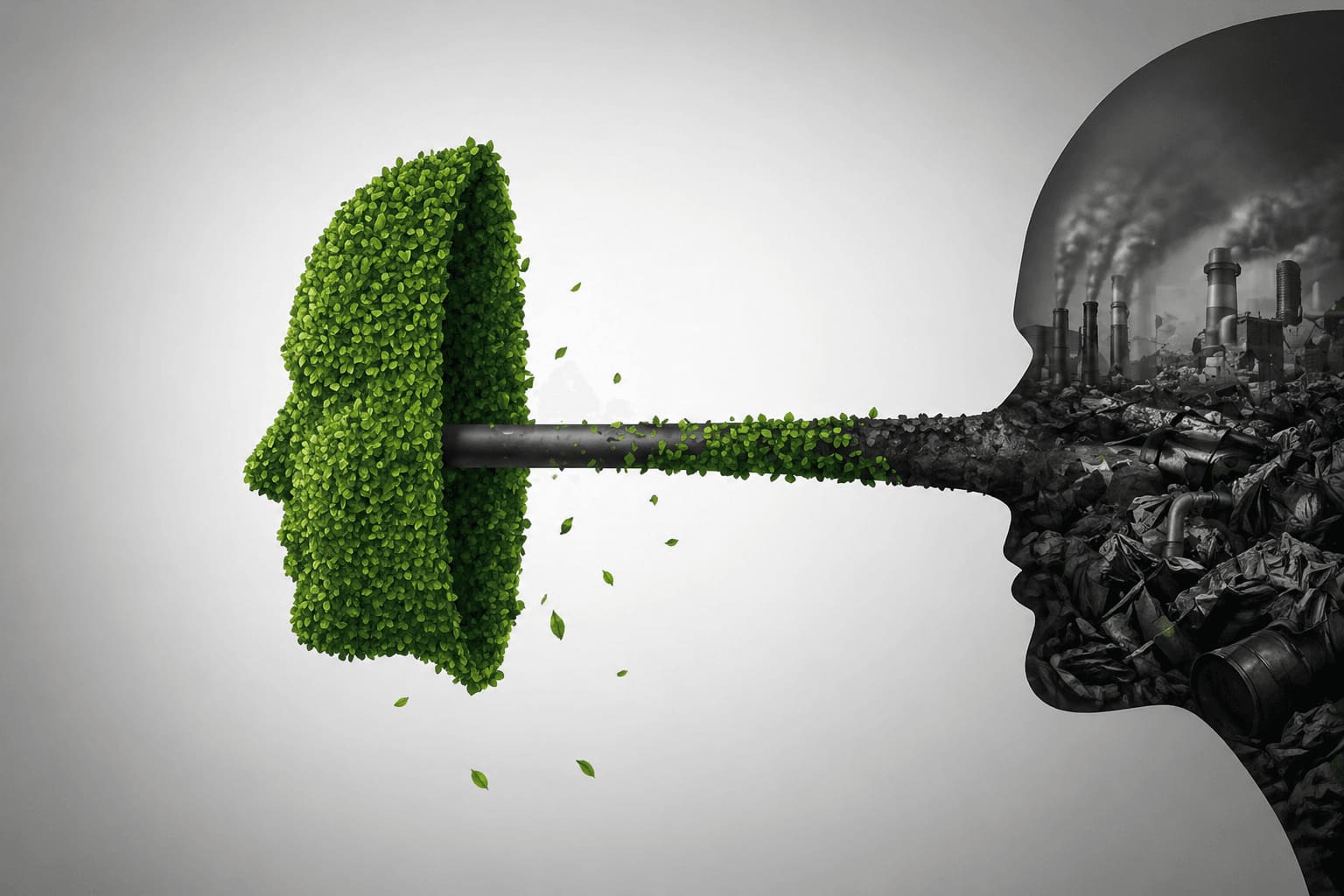
In recent years, we’ve seen an explosion of new “sustainable” products—or perhaps just new packaging. Most of the time, it was enough to look sustainable. Green packaging, words like “eco,” “natural,” or “responsible,” and well-crafted campaigns positioned products and companies as part of the environmental solution.
This trend has grown to the point where we now recognize the fine line between credibility, illusion, and even skepticism.
How far can an advertisement convince you, frustrate you, or make you believe even less?
If everyone uses these labels, it’s natural to start questioning them. Marketing and capitalism shout from the shelves. But will greenwashing always have its place?
The demand for sustainable and healthy solutions also increases the risk of greenwashing—practices that communicate environmental responsibility without real backing. The same happens in the food industry, where labels highlight reduced sodium or added protein, often masking misleading claims.
Greenwashing is not only about false statements. It also appears in omissions, exaggerations, or highlighting irrelevant actions compared to the overall impact. A common example is promoting a small “green” initiative while the core business remains linear and resource-intensive.
Identifying greenwashing requires looking beyond communication. Are there data? Transparency? Alignment between discourse and practice?
The good news: tolerance for superficiality is shrinking.
Pressure now comes from all sides—more informed consumers, stricter investors, and stronger regulations. Today, it’s no longer enough to claim. It must be demonstrated, measured, and tracked.
In the circular economy context, this leads to a simple but uncomfortable question: how can we prove something is truly circular?
Welcome to a new era: the age of proof.
From discourse to evidence
Circular economy is no longer just a concept—it demands rigor. It’s not only about recycling or reducing impact, but redesigning entire systems.
A product made with recycled material is not necessarily circular if its system does not ensure continuity, recovery, or reintegration.
Circularity requires systemic evidence.
The new foundation: data, traceability, and metrics
Proving circularity depends on reliable data. This drives technologies that track materials across value chains, including AI and blockchain.
Metrics such as circularity rate, real recycled content, product lifespan, and resource efficiency are becoming essential. Measuring is not just quantifying—it’s interpreting data within context.
What changes for companies and consumers
More than technology, this is about trust.
Companies must both implement circular practices and prove them. Consumers, in turn, develop greater critical thinking and prioritize credible brands.
Prove, transform, raise awareness
Circularity must be built, not just claimed. We are moving from a perception-based economy to an evidence-based one.
“Sustainable-looking” is no longer enough. The future belongs to what can be proven.

*Dr. Isabela da Cruz Bonatto is an ambassador for the Circular Movement, holding a Ph.D. and a Master’s degree in Environmental Engineering from the Federal University of Santa Catarina, with an MBA in Environmental Management. She works as a socio-environmental consultant, focusing on solid waste management, promoting the Circular Economy, and corporate sustainability. Residing in Kenya since 2021, she is a board member of the Together for Better Foundation and works directly with NGOs to combat period poverty and develop sustainable waste management solutions.
*This text was automatically translated with the help of artificial intelligence and reviewed. Still, there may be slight differences compared to the original version in Portuguese.
This content stays open because many people support it.
The Círculo do Movimento brings together those who give every month, from R$ 17.
Cancel whenever you want, in one click.
citar este artigo
MOVIMENTO CIRCULAR. The End of “Looks Sustainable”. Movimento Circular, April 27, 2026. Available at: https://movimentocircular.io/en/blog/the-end-of-looks-sustainable.
Your organization already has a circular agenda. What is its next step?
See how to take part