
artigo ·Fundamentals
From tailpipe emissions to lifecycle thinking: MOVER places vehicle recycling at the center of Brazil’s circular economy
Brazil’s MOVER Program brings recyclability, material recovery and traceability into automotive policy, advancing circular economy goals.
· 4 min de leitura
By Flávio de Miranda Ribeiro
The circular economy has firmly entered the agenda of Brazil’s automotive industry. One of the clearest signs of this shift emerged during the 6th meeting of the National Circular Economy Forum (FNEC), held in May 2026, with the participation of Movimento Circular as a guest organization.
During the event, representatives from Brazil’s Ministry of Development, Industry, Trade and Services (MDIC) presented advances within the Green Mobility and Innovation Program (MOVER) related to vehicle recycling. More than just a new government initiative, MOVER represents an important paradigm shift: it expands the sustainability perspective beyond tailpipe emissions and begins to consider the vehicle’s entire lifecycle.
What is MOVER?
Created through Law No. 14.902/2024, MOVER replaced the former Rota 2030 program and became Brazil’s main automotive industrial policy, focused on decarbonization, innovation, energy efficiency, and competitiveness. For the circularity agenda, however, the major milestone is the unprecedented inclusion of vehicle recyclability among the requirements for the Brazilian automotive sector.
In practice, this means vehicles will need to be designed with easier disassembly, component reuse, material recovery, end-of-life recyclability, and robust traceability mechanisms in mind.
According to the presentation made during the FNEC meeting, the program incorporates a circular design logic, encouraging vehicles planned for dismantling and material recovery. This represents a significant step forward compared to the historical focus of public policies in the sector, traditionally concentrated on emissions during the use phase, as seen in PROCONVE — the program created in 1986 that remains essential for improving air quality in Brazil.
MOVER, however, expands this perspective by adopting a cradle-to-grave approach, considering environmental impacts from raw material extraction to the post-consumer destination of vehicles. This aligns Brazil with the most recent international discussions on lifecycle thinking, circular economy, and producer responsibility.
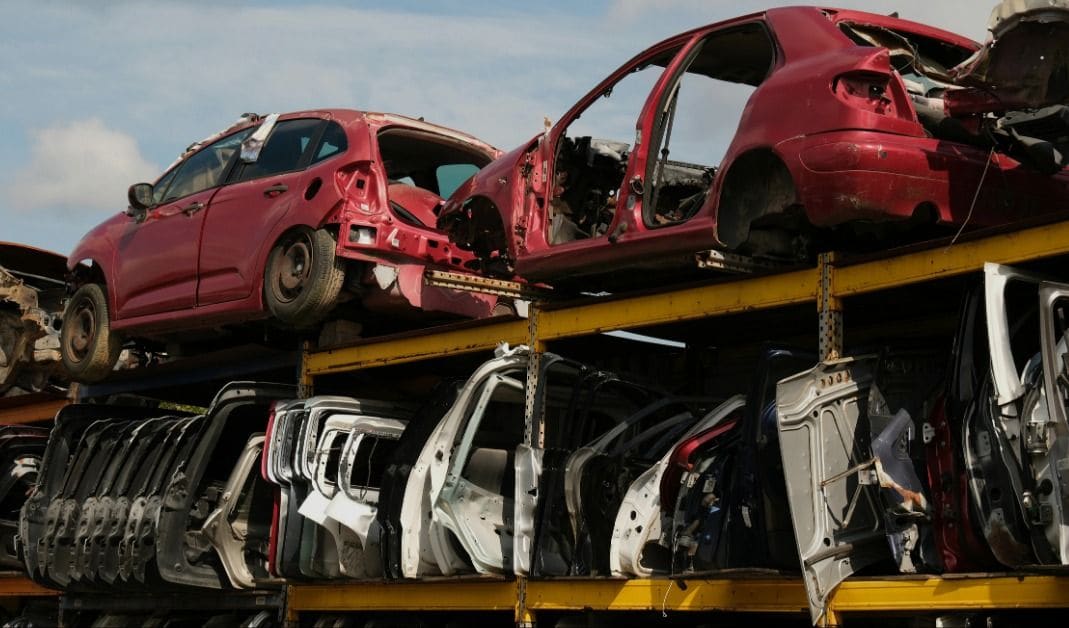
And this is no minor detail. Vehicles are true “mobile stocks” of valuable materials such as steel, aluminum, copper, glass, high-performance plastics, and even critical metals used in electronic components. Recovering the value of these materials — or even better, recovering parts and components themselves — means transforming waste into strategic sources of secondary raw materials.
The three pillars of vehicle recycling within MOVER
During the presentation to the FNEC, the MDIC structured the policy around three main pillars:
- Recyclability: The first step is measuring how much of a vehicle can effectively be recycled, using metrics aligned with international standards and technical requirements, such as mandatory dismantling manuals and component identification systems. Beyond increasing material recovery, this also tends to stimulate the professionalization of automotive dismantling, reducing informality and strengthening a structured recovery chain.
- Recoverability: The second pillar expands the focus toward reuse, remanufacturing, and recovery of components and valuable materials. The idea is to bring the Brazilian automotive sector closer to urban mining and industrial symbiosis strategies, prioritizing the extraction of maximum value from end-of-life vehicles.
- Advance material compensation: This may be the most innovative aspect of the model presented so far. The proposal creates a credit system based on physical and traceable proof of recycling through the so-called Vehicle Recycling Units (URVs), standardized accounting units representing quantities of automotive materials that have actually been recycled.
How does this logic work?
According to the logic presented by the MDIC, once a vehicle reaches the end of its life, it is sent to a certified operator responsible for formal deregistration, dismantling, and proper recovery of parts and materials. These items are then measured, tracked, and audited for the issuance of corresponding credits.
The key differentiator lies precisely in traceability, since credits are only generated from recycling that has actually been carried out, distinguishing this model from purely declaratory systems.
Although the model is still under development — including equivalence factors by material type and end-to-end traceability systems — its potential is significant. Brazil has an aging vehicle fleet, a strong market for used parts and metal recycling, and growing global demand for critical materials.
Benefits and challenges
Expected benefits include greater formalization of vehicle recycling, increased recovery of strategic materials, encouragement of new business models, and integration with climate and decarbonization goals.
At the same time, the challenges are considerable: robust traceability systems will need to be developed, operators accredited, databases harmonized, oversight strengthened, and legal certainty guaranteed for all stakeholders involved.
Even so, the main message presented by the MDIC during the FNEC meeting was clear: MOVER inaugurates a new phase in Brazilian industrial policy, demonstrating that circularity and competitiveness not only can, but must, move forward together.
By placing recyclability, material recovery, and traceability at the center of automotive policy, Brazil takes an important step toward transforming how vehicles are produced, used, and recovered in the coming decades.
Now, it is time to make circularity happen.
Consultant and Professor in Circular Economy, Reverse Logistics, and Environmental Business Regulation. Mechanical Engineer, specialist in Environmental Management and Technologies, and Multidisciplinary Analysis of the State of the World. Master in Energy and PhD in Environmental Sciences. Circular Economy Advisor for the UN Global Compact. Professor in the Postgraduate Program in International Environmental Law at the Catholic University of Santos, at FIA Business School, and at Trevisan Business School.
*This text was automatically translated using artificial intelligence and subsequently reviewed. However, minor differences may still exist when compared to the original version in Portuguese.
This content stays open because many people support it.
The Círculo do Movimento brings together those who give every month, from R$ 17.
Cancel whenever you want, in one click.
citar este artigo
MOVIMENTO CIRCULAR. From tailpipe emissions to lifecycle thinking: MOVER places vehicle recycling at the center of Brazil’s circular economy. Movimento Circular, May 12, 2026. Available at: https://movimentocircular.io/en/blog/from-tailpipe-emissions-to-lifecycle-thinking-mover-places-vehicle-recycling-at-the-center-of-brazil-s-circular-economy.
Your organization already has a circular agenda. What is its next step?
See how to take part