11/02/2026
From design to disposal: how the circular economy redefines value in Electrolux Group’s business
By João Zeni*
Sustainability Director, Electrolux Group Latin America
We are living in a moment when the circular economy has definitively moved beyond a conceptual discussion to become a strategic pillar for companies that want to thrive in the 21st century. Climate urgency, natural resource scarcity, and growing pressure for operational efficiency and environmental responsibility require organizations to fundamentally rethink how they design, produce, distribute, and dispose of their products.
Global data reinforces this urgency. According to the Circularity Gap Report 2025, only 7.2% of resources return to the economy after use, highlighting how dominant the linear model still is in global production logic. This scenario makes it clear that optimizing isolated processes is not enough: entire systems must be redesigned, from design to disposal, to reduce dependence on virgin raw materials and avoid large-scale waste.
At Electrolux Group, we see the circular economy not as a complement to our strategies, but as a guiding principle for the company. Present in nearly 70% of Brazilian households, the Group understands that its scale also brings proportional responsibility. That is why circularity is embedded in our global decarbonization targets, validated by the Science Based Targets initiative (SBTi), and guides strategic decisions across the entire value chain.
At Electrolux Group, we structure our Circular Economy approach around three main pillars: Use Less, Use Longer, and Use Again. With this perspective, we consider actions ranging from raw material extraction to product use and end-of-life management.
An important aspect of this approach is that it requires alignment across virtually the entire organization, as it involves demands that impact areas ranging from design and research and development to logistics, manufacturing, procurement, and after-sales.
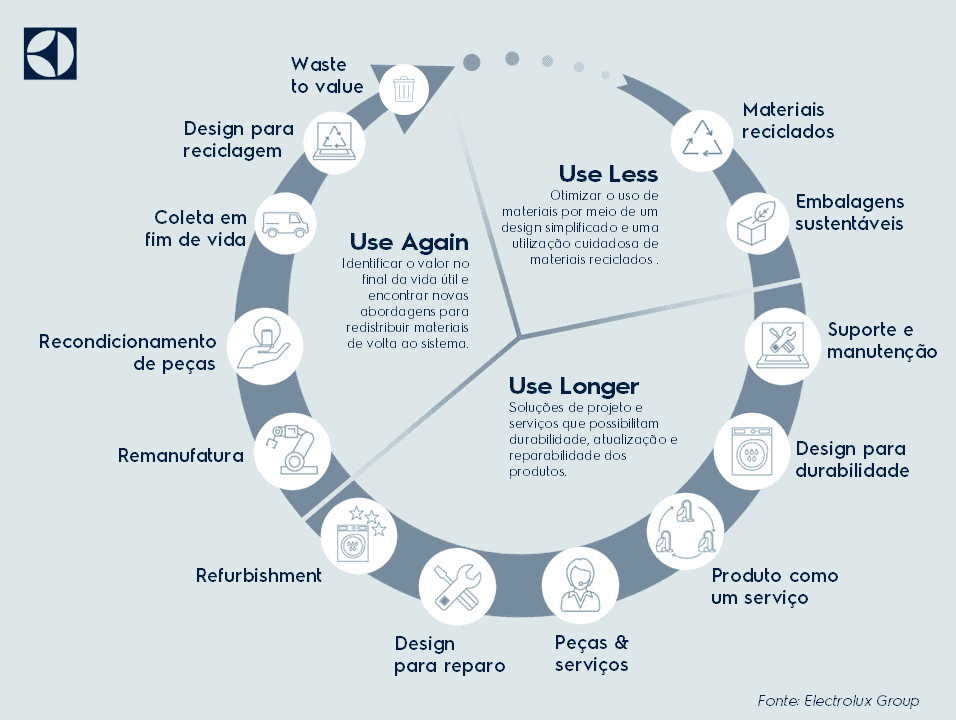
In this sense, it is worth noting that everything starts with design. Designing products that are more efficient, durable, and prepared for multiple life cycles is essential to reducing environmental impacts without compromising performance or the consumer experience. We have made progress in reducing materials and dimensions in certain products — such as water purifiers up to 27% smaller — eliminating unnecessary painting to improve recyclability, and progressively replacing refrigerant gases with higher environmental impact, a transition already completed 100% in Latin America, in line with the UN’s Cool Coalition platform. As a result, design moves beyond aesthetics or functionality and becomes a strategic tool for circularity.
Another central pillar of this transformation is the increasing use of recycled materials, enabling us to reduce the use of virgin raw materials. This effort requires deep involvement from manufacturing, procurement, and R&D teams. In Brazil, we already use more than 3,000 tons of post-consumer recycled plastic per year, a figure that continues to grow. Some of our products contain more than 50% recycled content while maintaining the quality and safety standards of virgin materials. In addition, the plastic used is itself recyclable, reinforcing closed-loop logic and reducing the need for new resource extraction.
Procurement and Research & Development play a critical role, as these advances are only possible through strategic partnerships across the value chain. We collaborate with suppliers and material companies that share the same ambition, such as in the use of high-performance recycled resins developed jointly with the chemical industry. These alliances allow us to scale circular solutions, reduce product carbon footprints, and strengthen the entire recycling ecosystem.
When it comes to packaging, the Group works on two fronts: reducing plastic use and fostering the circularity of materials that cannot yet be replaced. To that end, we have implemented plastic films with 30% post-consumer recycled content in some product lines (washing machines) and eliminated more than 98% of plastic in small appliances. As EPS remains an important material to prevent damage to large appliances, and while we continue to seek alternatives, we launched in 2026 a project to test incentive models for EPS recycling, initially with cooperatives in the Curitiba region.
Circularity, however, does not end at the point of sale. During the product use phase, we also strive to stay close to our consumers by expanding product repairability, ensuring spare part availability, and operating one of the largest authorized service networks in Brazil. In addition, since 2024, our proprietary platform Electrolux Cuida (https://cuida.electrolux.com.br/) has facilitated access to technical assistance and provided product maintenance tips.
Another example involves products that are damaged or returned during the delivery process and sent back to our facilities for what we call remanufacturing. These remanufactured products undergo quality inspections similar to those applied to new products and are sold at reduced prices through our Outlets across Brazil.
At the end of a product’s life, we also recognize that the manufacturer’s responsibility extends to post-consumer management. From this perspective, we created the Conscious Collection and Disposal Service, a pioneering initiative among appliance manufacturers in Brazil. The program has already collected more than 14,000 appliances, totaling 680 tons of properly recycled materials, regardless of the brand returned. The same truck that delivers a new appliance collects the old one, reducing logistics-related emissions and making proper disposal simple and accessible for consumers.
When a new purchase is not made, the company maintains a partnership with OpenCE and Industria Fox — the largest white goods recycler in Brazil — to facilitate the disposal of old appliances by consumers. Learn more at: https://descarteconsciente.org/
This initiative demonstrates in practice how the circular economy can generate environmental, social, and operational value simultaneously. Our operations are also strongly connected to circularity: all factories in Latin America are Zero Landfill certified, and our offices follow a zero-plastic approach. Moreover, it connects global climate targets with everyday consumer behavior and reinforces that sustainability does not need to be complex to be effective.
Circularity and decarbonization go hand in hand. Today, 100% of the electricity used by Electrolux Group in Latin America comes from renewable sources, and we continue to make consistent progress in reducing emissions across the value chain. Industrial projects, such as the new São José dos Pinhais plant (PR), were designed to operate with a low carbon footprint and with the ambition of zero waste to landfills, demonstrating how industrial innovation and sustainability can — and must — advance together.
Many of the actions Electrolux Group had already implemented to enhance the consumer experience were aligned with circular economy principles. Taking a more strategic approach and connecting this concept to existing initiatives brings significant contributions, especially as the circular economy has evolved from being merely an environmental tool into a competitive differentiator, a factor of corporate reputation, and a clear expectation from consumers, markets, and investors. Companies that embed circularity at the core of their strategy build more resilient, innovative, and future-ready businesses.
Within this broad circular economy context, it is also important to highlight regulatory trends related to the topic, particularly in Europe, as well as the regulatory framework being developed in Brazil, such as the new National Circular Economy Policy and the National Circular Economy Strategy.
I am convinced that this movement is no longer optional. The circular economy represents a new industrial paradigm. Organizations that understand this now will not only reduce risks and impacts, but also help shape a more balanced, efficient, and sustainable development model for the decades ahead.
_______________________________________________________________________________________
*João Zeni is Sustainability Director for Electrolux Group in Latin America, where he has led the regional strategy aligned with the global For the Better framework for more than five years. An Environmental Engineer, he has extensive experience in ESG, circular economy, and reverse logistics, integrating innovation, efficiency, and positive impact into business operations.
*This text was automatically translated with the help of artificial intelligence and reviewed. Still, there may be slight differences compared to the original version in Portuguese.